


Here’s a truth most people only fully understand after they get sick or, more often, after they’ve been delayed, denied, or run over by a system that sometimes feels designed to wear you down.
If you don’t take ownership of your healthcare, no one else will. Not your doctor, not your employer, not your insurance company, not the hospital, and certainly not the government.
That doesn’t mean the people working inside those systems are uncaring. Many are dedicated professionals doing their best every single day. But the systems themselves aren’t built to carry you. They’re designed to process claims, manage costs, enforce rules, and keep operations running. When you don’t know how those systems actually work, you quickly end up reacting to decisions instead of shaping them. You become a passenger instead of the one in the driver’s seat.
I didn’t learn this from a single dramatic moment. I grew up surrounded by it. Healthcare wasn’t some abstract concept in my family. It was daily life. From hospital finance to clinical care, from caregiving to social work, I saw how the system operates from multiple angles, and how differently it looks depending on where you sit. That early exposure shaped how I see healthcare today.

My path into health policy wasn’t planned. While working as a talent executive in Los Angeles, what started as storytelling quickly evolved into something much bigger: helping patients understand and influence the policies that shape their lives.

A pivotal moment in that journey came when I met my mentor, Selma Schimmel. Selma founder of Vital Options, the first organization dedicated to young adults with cancer. She had earned a PhD in her own cancers, and she taught me more about the system than almost anyone else. Above all, she drilled into me one essential truth: no one else is going to take control of your healthcare but you and hopefully someone you trust as a caregiver when you need it.
That experience, along with everything that followed, eventually led me to co-found Patients Rising, where I’ve spent more than a decade at the intersection of patient advocacy and public policy.
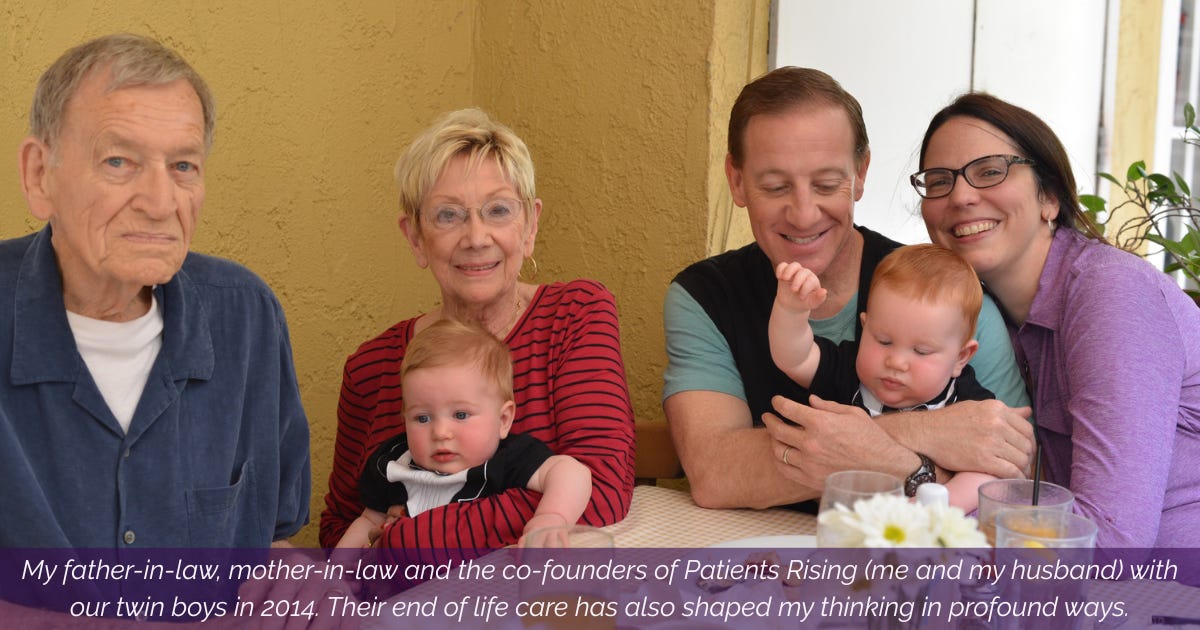
During that same decade, I also stepped into the caregiver role myself. I supported aging parents, stepparents, and in-laws while raising twin boys. Between 2019 and 2025, I lost my father-in-law, my dad, and my mother-in-law. Watching how the system interacted with them as they aged — and how differently it treated them compared to younger patients — shifted my perspective in profound ways.
In America, we often talk about healthcare as something that simply “happens to us.” You get sick, you go to the doctor, you follow instructions, and you hope for the best. That passive approach may have worked reasonably well decades ago, but it no longer matches today’s reality.
Healthcare today is shaped by a vast web of policies, incentives, pricing structures, and coverage rules. Many of them decided far from any exam room. Those distant decisions quietly determine what treatments you can access, how much you’ll pay, what your insurance will actually cover, and sometimes even what options your doctor is allowed to discuss with you.
It can feel overwhelming. The good news is you don’t need to become a policy expert. But you do need to grasp one core truth:
You are the CEO of your own healthcare.
You didn’t ask for the role. It’s not always fair. But in the US healthcare system, it is the reality. Accepting it is the first step toward real control.
Being the CEO doesn’t mean you have all the answers. It means you show up differently. You ask sharper questions. You explore your options instead of accepting the first one presented. You pay close attention when something feels off. And above all, you stop assuming the system is automatically working in your best interest. Most importantly, you refuse to stay on the sidelines.
Here’s what surprises many people: The decisions that most affect your care are rarely made at the hospital bedside or in your doctor’s office. They’re made in state legislatures, federal agencies, regulatory boards, and closed-door budget negotiations. They carry technical names and acronyms that are meaningless for your average person. Drug pricing rules, coverage mandates, PBM formularies, hospital payment models, NBPP, PDUFA, PDAB, the 340B program (sounds like a tax form), and utilization management policies that can quietly restrict access.
What does it all mean to you?
On paper these issues sound abstract and bureaucratic. In reality, they become intensely personal the moment they limit the medication you need, drive up your out-of-pocket costs, force you to switch providers, or add months to your wait time for care.
If you don’t understand the forces at play, you can’t effectively respond when they touch your life. You’re left hoping someone else — somewhere — is looking out for you. Sometimes they are. Too often, they’re not.
That’s exactly why I’m launching State of the Patient.
This isn’t another space to rant about everything wrong with healthcare or to push a particular agenda. My goal is simpler and more practical: to explain what’s actually happening in health policy and why it matters to you and your family. I’ll try to keep it in plain English, without the jargon or noise.
In the weeks ahead, we’ll break down complex issues into clear, actionable insights. We’ll look at how decisions made in Washington or state capitals ripple into real life — in exam rooms, pharmacies, and kitchen tables. And we’ll focus on what you can actually do about it.
Because once you understand the system — even at a basic level — something important shifts. You stop feeling powerless. You stop being passive. You start leading your own care.
Healthcare is deeply personal. The system behind it isn’t.
And if we want a system that truly works better for the people it’s meant to serve, it has to start with something basic but powerful: more individuals who are informed, engaged, and paying attention.
This is State of the Patient. We’re just getting started, and I’m glad you’re here.
Enter your email and hit the Subscribe button above and become part of State of the Patient.
You’ll get new posts and podcast episodes as soon as they drop — no spam, no noise, just the clear information you need to navigate and advocate your way through the system with confidence.
Thanks for being here.
Yours in Advocacy,
~ Terry