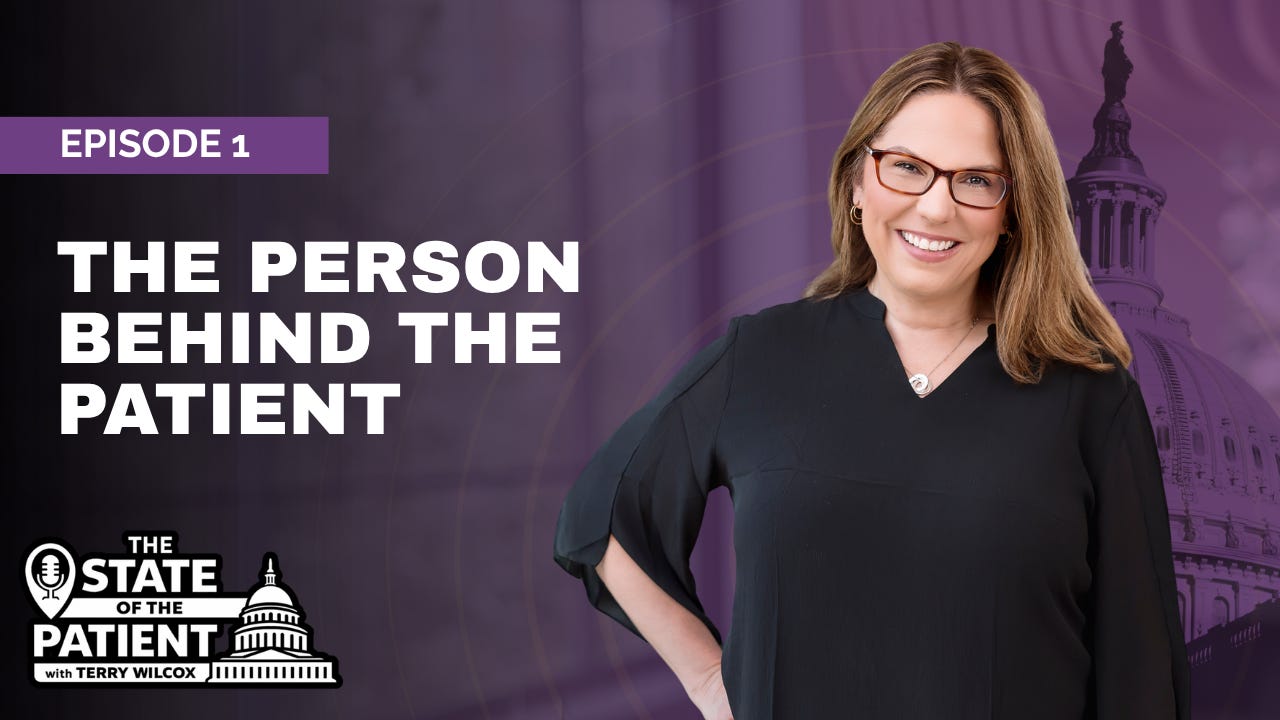
I’ve spent years in patient advocacy, and if you asked me to boil down everything I’ve learned into one sentence, it would be this: when you peel back the label of “patient” or “advocate,” there is always a person underneath.
Somebody with a job, or a family, or a garden, or a beagle they walk in the morning. Somebody who, before any of this happened, never thought about prior authorizations or step therapy or PBMs. They just lived their life. And then something happened.
That’s the whole reason I started the State of the Patient Podcast — and it’s why, for the very first episode, I didn’t want to lead with policy or a piece of legislation. I wanted to lead with people. Four advocates, four different conditions, four different corners of the country. I want to introduce you to them here, because I’m still thinking about all four of them, and I suspect I will be for a while.
Greg says “I meant to do that”
Greg Josephs is a real estate guy from New Jersey with a beagle and a garden and myasthenia gravis, which he’s had for over twenty years. It took six months and a parade of specialists to diagnose him — one told him he was crazy, one wanted to cut into his head, one guessed ALS — before a chest X-ray finally pointed to MG. “Good news,” the doctor told him. “You have MG.”
Here’s what I love about Greg. He’ll tell you MG isn’t life-shortening, it’s life-limiting — and then he’ll make you laugh about it. When he stumbles stepping off a curb, he looks around and says, “I meant to do that.” His favorite joke is a knock-knock joke. Knock knock. Who’s there? HIPAA. HIPAA who? “Can’t tell you.”
But underneath the jokes is real wisdom. Greg runs a support group built on three C’s — comfort, compassion, companionship — because when you’re newly diagnosed with something you can’t pronounce, what you need first isn’t a treatment plan. It’s somebody who’s been there. And when I asked what he wants from policymakers, he didn’t say “pass a bill.” He said he wants med students trained to sit with uncertainty and look at the whole person instead of rushing to a label. “Smiling is easy,” he told me. “And wonderful treatment.”
Michele found out a computer denied her — three times
Michele Rayes is a pharmacy tech from Texas, a cancer survivor since she was 22. She became an advocate through her job, watching PBMs squeeze her patients — and then realizing she’d been quietly getting squeezed herself. She’d been paying cash for her own medication because it was cheaper than using her insurance. Let that sink in.
Last year, the first drug ever developed for her rare condition came to market. She’d waited 30 years. Her insurer denied it. She appealed. Denied. Appealed again. Denied. Then came the letter: “You’ve exhausted all appeals.”
Most people stop there — less than one percent of denials ever get appealed at all. Michele called and asked how her appeals had been reviewed. The answer: a human eye had never looked at any of them. Every denial was AI. So she turned her story into the face of a Texas bill banning AI-only insurance denials, and she helped write the protocol. What she wants is simple, and it’s stayed with me: “I didn’t ask to be ill. Just treat me as a human. Plain and simple.”
Vickie got handed a $9,740 bill that was never hers
Vickie Wilkerson is from Louisiana — her congressman is Speaker Mike Johnson, and yes, she’s met him in his office. She’s been to DC five times for psoriasis patients. Her insurance actually approved her new biologic quickly. The problem was the specialty pharmacy, which told her the copay for a single shipment would be $9,740 — and wanted to ship it first and figure out the money later. Biologics can’t be returned. Once that box is on the way, you own it.
Vickie said no. She pushed back, got her patient assistance program to cover what it was supposed to, and got her medication. But she has to do this every three months. And here’s what keeps me up: if this happens to Vickie — a five-time DC advocate who knows exactly what a copay accumulator is — what happens to the patient who reads “$9,740” and just stops?
Michelle brings her laundry on stage
Michelle Castile is from rural Wisconsin, and her crisis didn’t start with a diagnosis. It started with her house. A government weatherization program made mistakes that wrecked her home’s air quality. It took two years and experts from all over the country to diagnose. By then her daughter had asthma, her son was always sick, and Michelle herself was disabled and nearly lost her eyesight.
When the state denied her requests for home-delivered meals and a shower door, she decided the caseworkers were simply burned out — and instead of giving up, she built a presentation about it. It’s called “Lessons Through Laundry,” and she folds laundry live on stage, because that’s what she does when she’s anxious and she refuses to hide it. Three years ago she was a stay-at-home mom who’d never spoken in public. Her advice: “There’s nowhere it can go besides up when you’re at the bottom.”
What I keep coming back to
When I lay these four stories next to each other, I keep hearing the same three things.
The system is designed to be exhausting. The denials and appeals and phone trees work because most of us, most of the time, give up. That’s the whole business model. Less than one percent of denials get appealed — not because patients are lazy, but because they’re worn down.
There is a person behind every patient. Greg was a real estate guy. Michele was a young woman with her whole life ahead of her. Vickie was a wife. Michelle was a mom folding laundry. Every one of them is more interesting than their diagnosis.
None of them did it alone. They each plugged into something bigger — a support group, a foundation, an association, a movement. That, more than any single law, is what made them effective.
So if you’re at the beginning of something right now — a new diagnosis, a denial letter, a system that just stopped working for you — take this from Greg, Michele, Vickie, and Michelle: you have to be the CEO of your own healthcare. Nobody is going to do it for you. But there are people who will help, and there are advocates who have walked the road ahead of you and left a trail.
Go listen to the full conversation with all four of them right here in Substack or in your favorite podcast app. And if one of these stories sounds like yours, hit reply — I read everything.