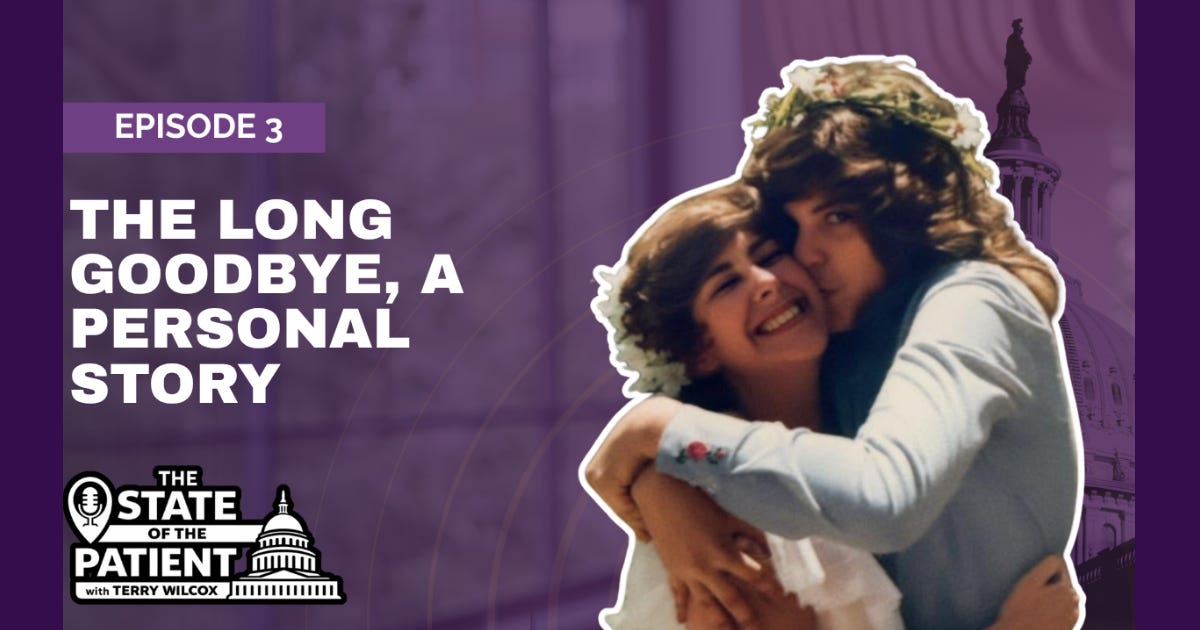
They call it the long goodbye. I’ve used the phrase myself. But it’s gentler than the thing it describes, and I’ve started to resent it a little.
A goodbye is something you get to say. To someone who knows you’re saying it.
My stepmother Sandy died last week. She was eighty. I recorded an episode about her this week, and it’s linked below if you want it — but that one has a job to do. It’s about early detection and insurance coverage and two bills sitting in a committee, and I stand behind every word of the advocacy.
This isn’t that. This is the rest of it.
Sandy was glass-half-full in a way that should have been annoying and somehow never was.
She had cat things all over her house. Cat mugs, cat towels, a cat clock. A Felix the Cat clock. Which was funny, because early on she had announced to all of us, with some conviction, that she was absolutely not going to become the crazy cat lady.
She became the crazy cat lady. Gloriously. She showed Himalayans — took them all over the country, and once as far as Russia, which I still can’t entirely picture. Pixie, Luke, Leia, Yoda.
When she died, her goddaughter Gennifre said there would be a thousand cats waiting for her at the pearly gates.
At least a thousand. Gennifre’s probably low.
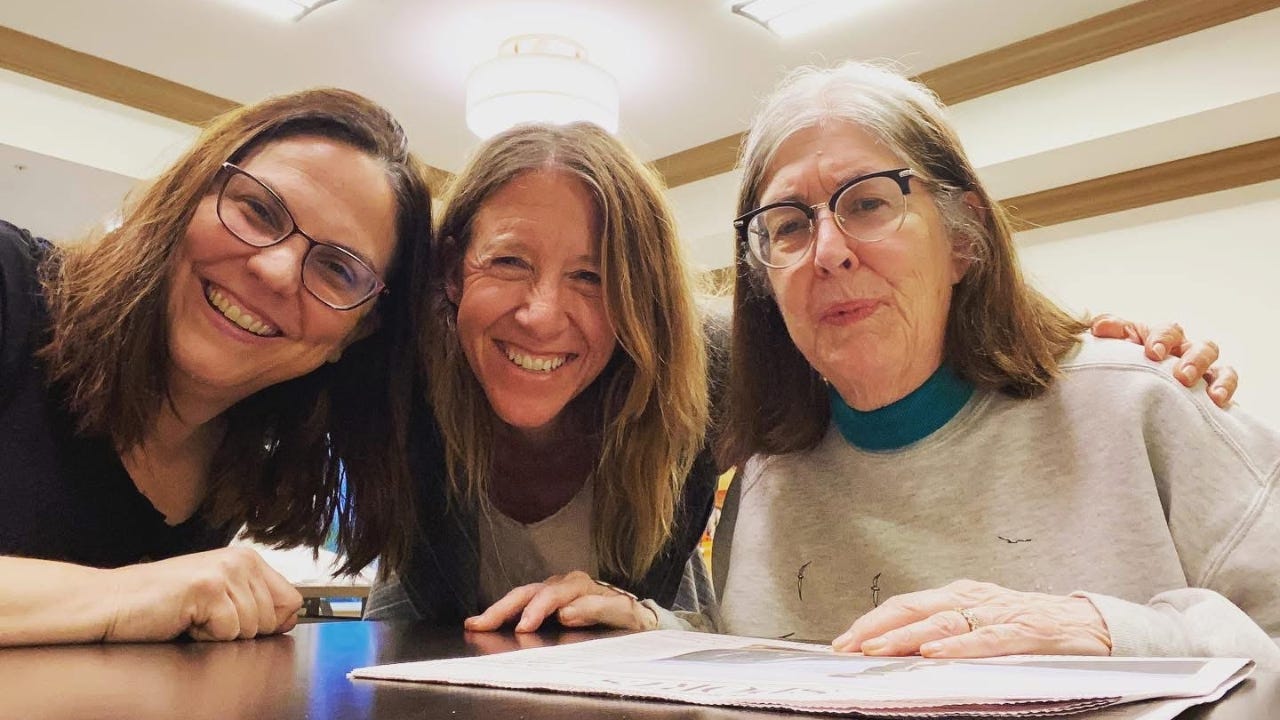
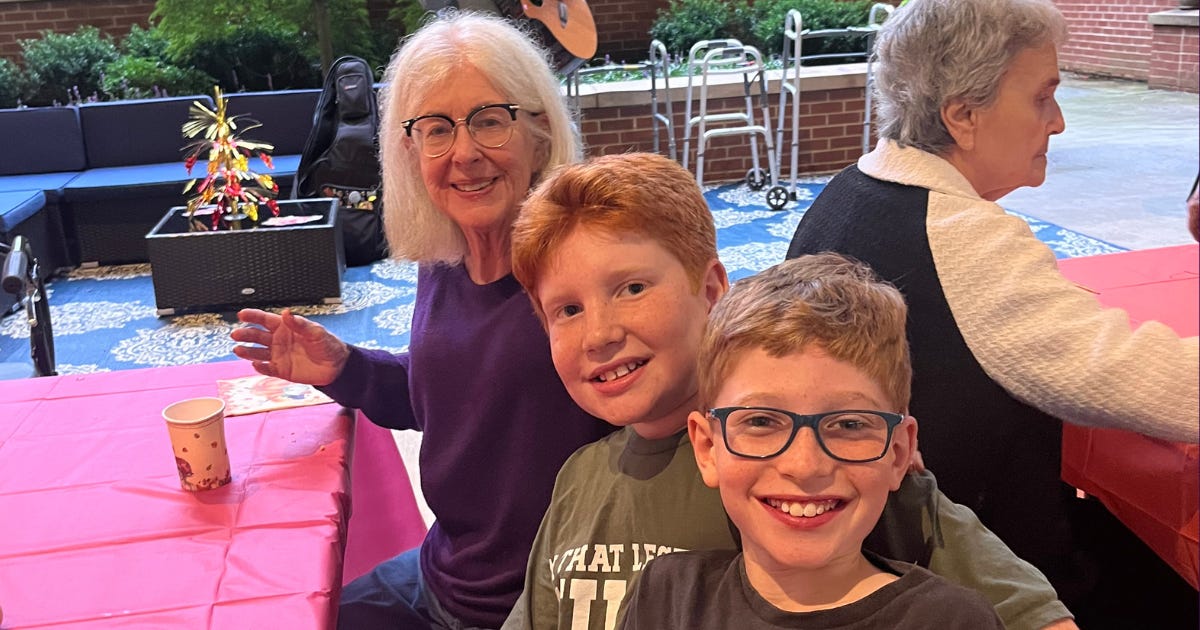
This is Sandy, Gennifre and me about two years ago, it seems like yesterday and a lifetime.
Gennifre and I go waaaay back. Back to before my Dad and Sandy were married. Back to an era where you ran feral in the summer afternoons while your parents worked. Lucky for us (and our parents) our biggest adventures were walking to the grocery store to make dinner, of course we only did that once that I can remember. I’m certain that we also did things where we would not answer yes if someone were to ask us if we thought our actions were “the best choice.”
One afternoon I was reading the Colorado Cache cookbook and I decided we were going to prepare chicken divan, cheesecake and margaritas. I was older, so I decided most things. After we returned from the grocery store with our sack of needed ingredients, I called Sandy to see if she had any te-quill-ee-a.
“Sandy, we need te-quill-ee-a for dinner,” I said with as much authority as an eleven year old could muster.
“You need what!?!” she asked, trying not to laugh.
“Te-quill-ee-a. We want to make margaritas for everyone.” I replied.
I think Sandy told this story (while still trying not to laugh) in my presence at least 100 times over forty years.
The end of that story is we did make a fabulous dinner for everyone, and my Dad made the margaritas. I can’t promise you he did not also make one for us, after all, it was the 80’s.
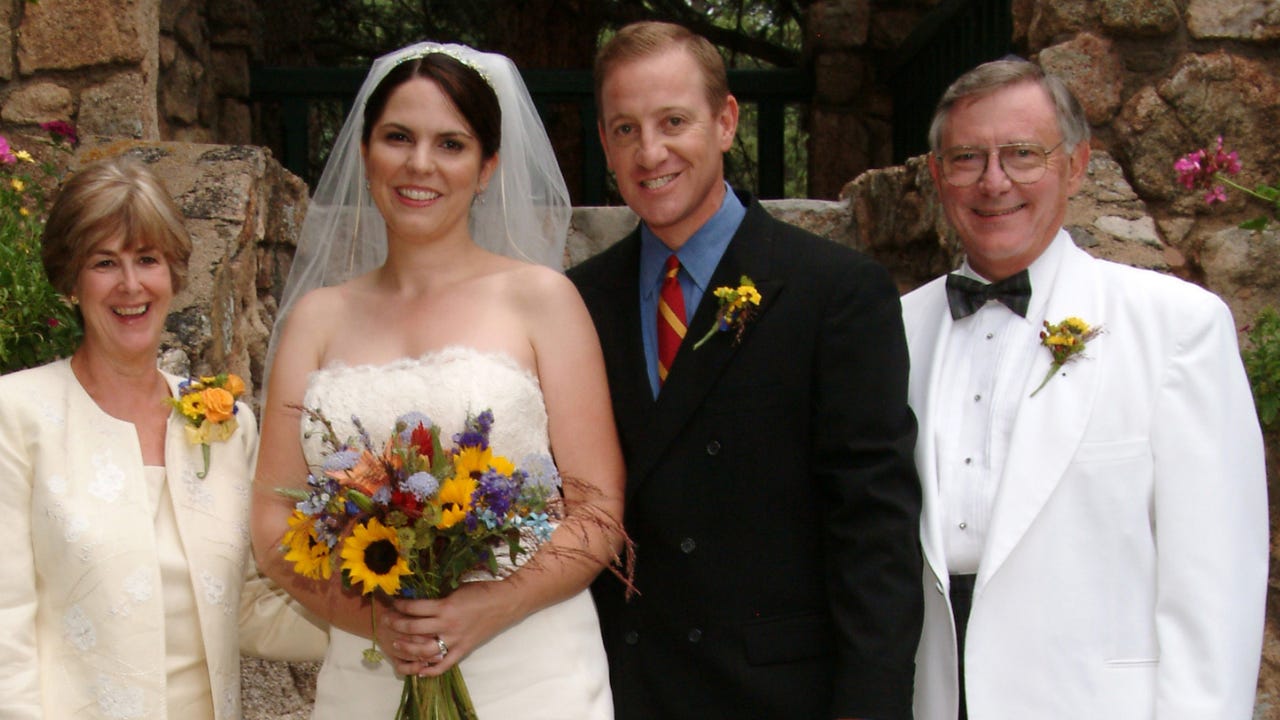
I was married on August 12, 2007 at the Meadow Creek Lodge in Pine, Colorado. When we were planning the wedding I had no idea where I wanted to get married. I was so much later than most of my friends even getting married, that you probably could have talked me into Vegas or the Los Angeles County Court House. I think my Mom would have given me money to do either, but Sandy had other ideas.
Sandy was always ready to hug you, listen to you, help you untangle whatever mess you’d made. And yes, help you find a magical wedding venue that you never would have even considered on your own.
Here’s the part I’ve never really talked about publicly until this podcast.
Sandy gave forty years to the Colorado Hospital Association. She was Director of Education and Member Services. She was good at it. She loved it.
She started forgetting things in her late fifties, and they started taking her responsibilities away, one at a time, until there was nothing left to take.
I’m not angry at anyone. There simply was no test to give her. In the mid-2000s, confirming Alzheimer’s meant a spinal tap or a PET scan, and nobody sends a fifty-eight-year-old for either one because she’s misplacing things and forgetting that she has already bought milk three times this week.
I’m not sure what she was told it was or if she even asked. We know more now than we knew even five years ago, honestly. Lucky for future Sandy’s — there is a lot of research happening, but we need a lot more.
One researcher did scan her brain around 2007 with something new that was supposed to “catch this early”. It came back negative. Her brain was declared fine. My dad and I looked at each other in the parking lot and said, that test is going nowhere.
It didn’t.
Even Sandy knew on some level she should get long-term care insurance. It was the smartest thing she did. They do not make policies like the one she had anymore. Knowing what it costs, I am not sure I would even recommend today’s plans. You are better off saving your money for the day you hope will never come. After all, most of us want to go quietly in the night while sleeping peacefully in our own bed. My recommendation? Save your money and aim for staying in your own bed as long as possible.
Sandy wasn’t ready to retire when she did. Her brain retired without her. I’ve said that line about a dozen times this week because it’s true. I’ve never known anyone as content in her life, job and hobbies as Sandy was. I wish she was still here doing them.
The thing nobody prepares you for is that it isn’t one loss. It’s a hundred small ones, spread over years, and you don’t get to grieve any of them properly because she’s still right there in front of you. Yes, there are moments of Sandy and I cherished every one, but the Sandy I wanted to hang out with was now someone I was tasked with protecting.
There were stretches where she’d tell me — flatly, like she was reporting the weather — that my dad had left her for another woman.
He hadn’t. He was her husband until the day he died.
The one thing I really learned over the past six-plus years was that you can’t argue with Alzheimer’s. You can’t produce evidence. There’s no version of the conversation where you win. You pat her hand, you agree that it sounds hard, and then you go sit in your car in the parking lot and cry, and then you drive home and make dinner.
She brought a date to my father’s funeral. Her own husband’s funeral. She had no idea where she was or who we were burying.
I don’t know what to do with that memory even now. Some days it’s the saddest thing I’ve ever seen. Some days I think — well, at least she wasn’t sad that day. At least on the worst day of our lives, she was somewhere else.
Both of those are true. That’s the disease.
My Dad died in the same facility where Sandy passed last week. He died in quarantine, and the only blessing in his passing so quickly after arriving was that he had dialysis. No one figured out how to lock down a dialysis patient during Covid and for that I will be forever grateful. I picked him up three times a week and dropped him at dialysis, and on those rides with him I broke every Covid rule imaginable because something inside me knew our time together was going to be short.
I do not regret being a rebel.
I did not bring Sandy and my Dad into my home. I couldn’t.
I had two young children, twin boys. My mother-in-law was already living with us. My dad was recovering from a broken leg. Our miniature schnauzer, Harlow, genuinely terrified Sandy. There were lots of stairs.
I’ve made peace with it, mostly. But I want to say it out loud in case it can help someone who is reading this, because I know how many people there must be out there carrying this exact guilt in silence.
When I was a kid I wanted all of my family and friends to live on one giant cul-de-sac. All of us, in a ring, walking into each other’s kitchens. I still think that’s one of the most beautiful ideas there is. It just turns out that wanting it and being physically able to build it are two very different things.
My parents came to me kicking and screaming at seventy-three. Too late. By then she was already unable to care for herself (their car insurance was a mortgage payment at this point due to the accidents they were racking up).
If you’re of retirement age and reading this, go be near your kids. Not because they don’t love you or wouldn’t show up for you—they will. But they’re also working, raising children, and managing lives of their own. When an emergency comes, they can’t simply pick up their entire lives and move them to you. Being closer before the emergency happens makes it possible for them to be there when you need them most.
And it will come as an emergency. It came as one for us.
My Dad arrived at Dulles at around 3:00 in the afternoon the day the country shut down.
I got a call three days out — if your parents aren’t here by six o’clock on March 17th, we can’t let them in. So I moved them into assisted living, sight mostly unseen, just before the clock stuck six on March 17th, 2020.
Then the doors closed. I did not see Sandy again until the day my Dad died.
I don’t think we’ve reckoned with what COVID did to people with dementia. Everyone else in America was frightened, and being frightened at least gave us a reason. We knew why we were alone.
Sandy got none of that. You could explain the virus to her and thirty seconds later it was gone. There’s no fear without the ability to hold a threat in your head. There’s no patience without believing the thing will end.
There was just: my family stopped coming. Every day. Brand new every morning.
When they finally cracked the doors open, they put up a plastic outdoor room and handed us a karaoke microphone to pass back and forth.
Oh, the irony of that sentence.
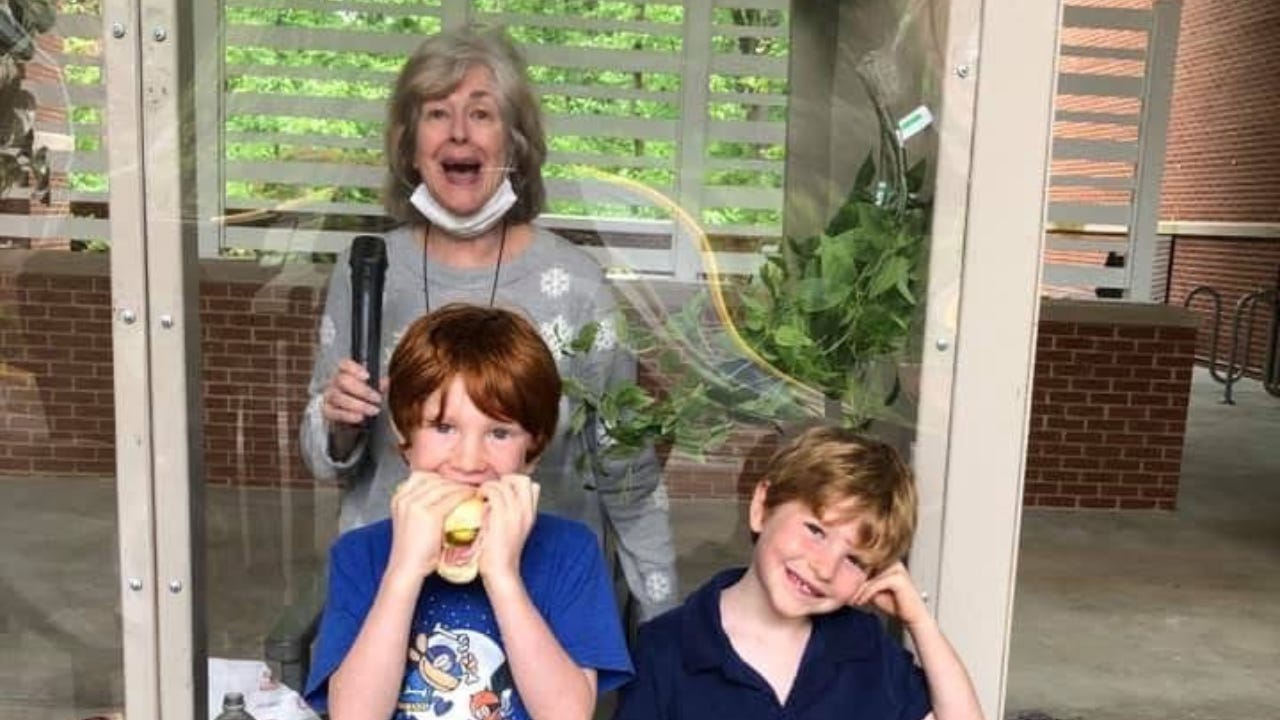
I would walk behind the booth to Sandy’s side, unwrap the sandwich we were supposed to be eating together, hand her the microphone, walk her through turning it on, walk back around to my side, and wait. And she’d talk — never into the microphone. And then she’d get confused and set the microphone down.
My son James finally just walked around the plastic and sat down next to her.
Mommy, I just want to sit by Nanny. I don’t want to talk into this dumb microphone.
He was six and he was right. It was ludicrous. That facility was doing its absolute best inside rules written by people who had clearly never sat across a clear plastic wall from someone with dementia.
She declined faster in those months. I’m certain of it. Every family I’ve talked to since says the same thing.
Sandy’s mother, Grandma Roberts, lived to ninety-eight. I remember her in her seventies, back from some trip overseas, handing twelve-year-old me gold lamé lipstick holders I had absolutely no use for and treasured anyway.
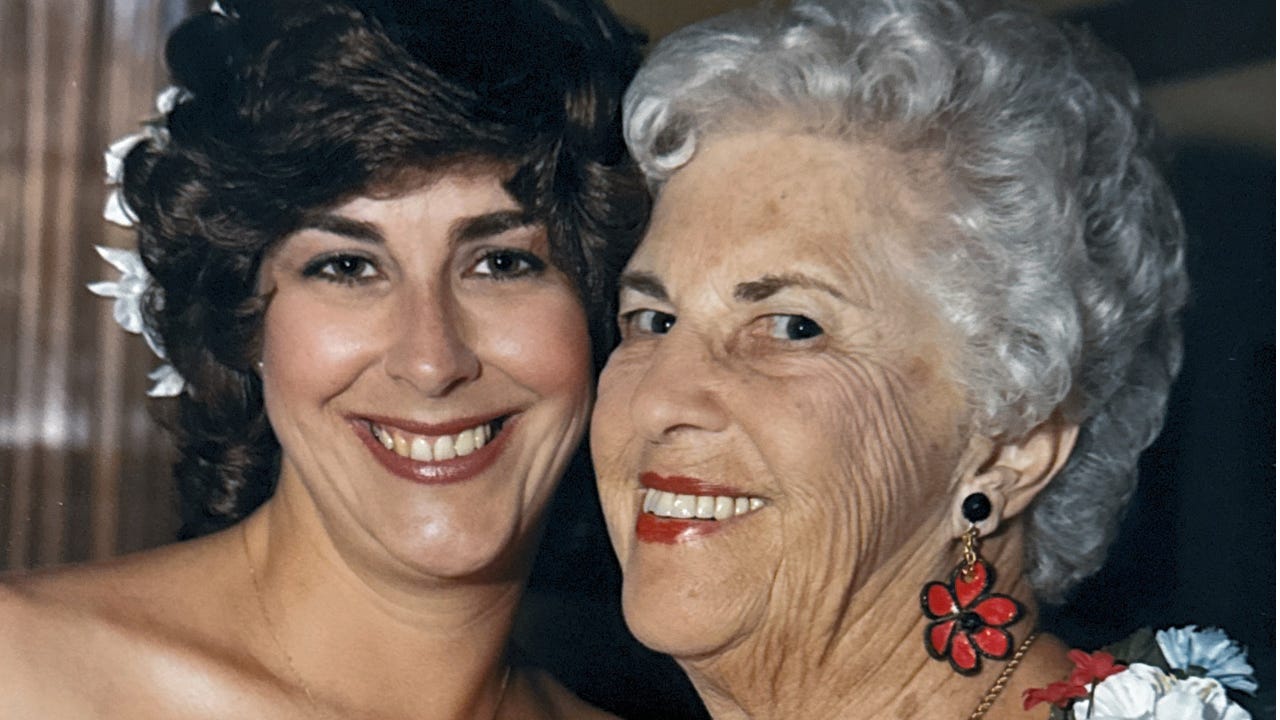
Sandy died at eighty.
Grandma Roberts was traveling the world in her 70’s. She did die of dementia complications, but she was 98.
At 73 Sandy could not drive to the grocery store and remember to take the groceries out of her car. This disease took almost twenty years off a woman who came from people who live to almost a hundred — the last of her working life, her travel, her cats, and any chance of my kids knowing her as anything other than their Nanny who needed help. Their Nanny who they loved and watched slip away.
And here’s the only policy thing I’ll say in this post, because I said the rest of it on the microphone.
If you want to listen to the episode you can stream below — and here is the [LINK] to more about the show and where you can listen.
There is a blood test now. FDA-cleared. A blood draw, the same tube they already fill at your annual physical. Everything Sandy didn’t have, collapsed into one vial.
Almost nobody can get it. Medicare won’t cover it as screening, and commercial insurance isn’t required to cover it at all.
What happened to Sandy was a limitation of her time. What happens to the next fifty-plus-year-old is a decision.
So if you take one thing from me this week: go ask. At your next physical, ask about cognitive screening and biomarker testing. Ask what you qualify for and what your plan covers. If it runs in your family, say so out loud in the exam room.
You may not like the answer. But you can’t act on information you never went to get.
I’ve been trying to figure out the best way to end this for an hour and I don’t have a clean ending, which feels about right. The ending itself was not clean. Are they ever?
Sandy was a huge part of my life for more than forty years. Forty-seven to be exact. She loved me as if I were her daughter and I loved her. She made a room better. She had the type of energy that could change a room just by walking into it. I always used to tell her how much I admired that. She had a refreshingly honest personality that people gravitated towards. I will miss her and all the cats. The one in the bottom right corner of this picture was one of my all time favorites, his name was Dennis.
She would have hated all this fuss and then secretly loved it.
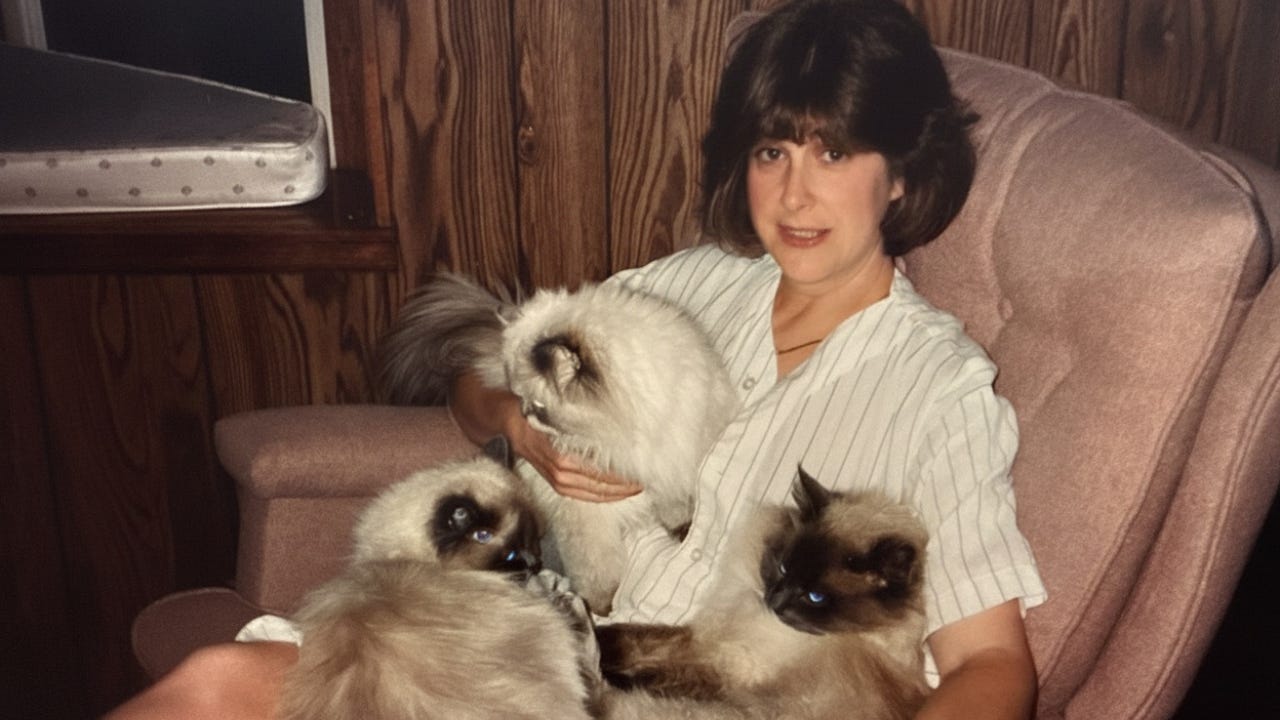
Sandy, I will think of you every day. I can’t wait to see you and Daddy again at the cul-de-sac in the sky — along with Dennis, Wizard, Raylan and, of course, Boomer Son of Ragtime.