I have been in a lot of rooms where a policy gets sold, and I have learned to listen for a particular sound. It’s the sound of a name doing work that the mechanism underneath it can’t do.
Prescription Drug Affordability Board. Say it out loud. It’s airtight. What are you going to be, against affordability?
I sat with a legislator here in Virginia a while back who told me, plainly, that we needed one of these boards because of inflation. He wasn’t being cynical. He wasn’t hiding anything. He had read the name and drawn the obvious conclusion, the same way you or I would.
That conversation has stayed with me, because it’s the whole problem in one exchange. The name is doing the work. Almost nobody has looked underneath it.
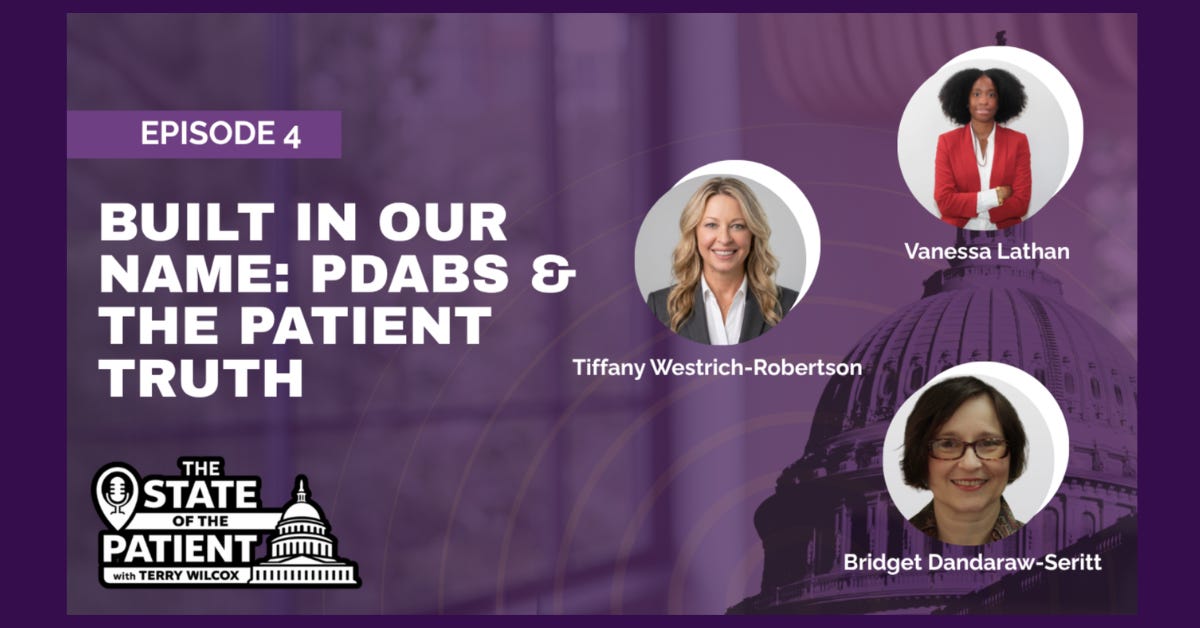
So this episode is me looking underneath it, with three women who have been living there for years.
Here is what everyone who takes a medication needs to know. When one of these boards sets an upper payment limit, it caps what your insurance reimburses the pharmacy. It does not change the price of your drug. It does not cap what you pay. Bridget Dandaraw-Seritt in Colorado says it plainly: you are still on the hook for the rest.
And whether any savings ever reach you isn’t a requirement. Tiffany Westrich-Robertson took me into the fine print, and the word she landed on has been rattling around my head ever since. It’s an “or.” The patient, or the state, or the insurer, or the pharmacy benefit manager. Four names on a list, and only one of them is you.
I want to be fair here. Nobody in this story set out to hurt patients. The people on these boards are volunteers. Tiffany says most of them will tell you they took the job because they wanted to help patients, and that she believes them. I believe them too. They were told this was about saving patients money. Some of them are figuring out that it isn’t, and that has to be a disorienting thing to discover about work you volunteered for.
And some boards are getting it right. Tiffany points out — and I think this is the single most useful fact in the whole episode — that the boards without the authority to set a price cap are the ones landing solutions that actually reach patients’ out-of-pocket costs. The tool everybody fought for turns out not to be the tool that helps.
Then there’s the board that told her team, straightforwardly, that it isn’t supposed to focus on patients’ out-of-pocket costs at all. Its job is capping costs at the system level for insurers. I want to give them real credit for saying so out loud. That’s more honesty than most of this debate offers. But read that sentence again and notice what it’s describing.
The part I can’t put down is Bridget’s number.
Many of these boards use something called a quality-adjusted life year to decide whether a drug is worth covering. One is perfect health. Zero is no benefit at all. Bridget has been on the same biologic for twelve years and it has given her her life back. It scores 0.13.
I asked what 0.13 looks like. Her spine has fully collapsed from a rare genetic disorder. She is still walking. Still gardening. She uses a wheelchair for long distances. And what she told me she wants — the thing she named — is to be able to get up and change the channel when she can’t find the remote. To take her grandkids outside.
That is a life. A spreadsheet scored it at 0.13.
And then there’s Vanessa Lathan, who complicated everything I thought I understood about this. Vanessa has fifteen years in public health and health policy. She lives with an autoimmune condition. She has never been on a biologic — she’d never heard of one until she joined this coalition. Most of her journey, she says, has been heating pads and prayer.
You cannot lower the price of a medication into a patient’s hands if nobody ever offered it to her.
Vanessa said something else that I keep turning over. She considers herself privileged — she works in this field, she has the access, she has the information — and she still learned more about her own condition from other patients than from the healthcare system. If she couldn’t get there on her own, what exactly are we asking of everyone else?
I say all the time that you have to be the CEO of your own healthcare, and I mean it. But Vanessa is doing everything right and the system is still not meeting her. That’s not a personal failure. That’s a design.
Affordability is not a price. It’s a relationship — between your coverage, your deductible, your assistance, your income, and your life. Any policy that treats it as a single number is going to miss most of what’s actually happening to you.
And if a policy is built in our name, then we have to be the ones it’s actually for.
The coalition behind this work is collecting patient stories right now. Any form — video, writing, a few sentences. Vanessa’s line about it is the most generous framing of advocacy I’ve heard in a while: there’s nothing too small. Start where you’re at.
Share your story: [PIC STORY FORM LINK]