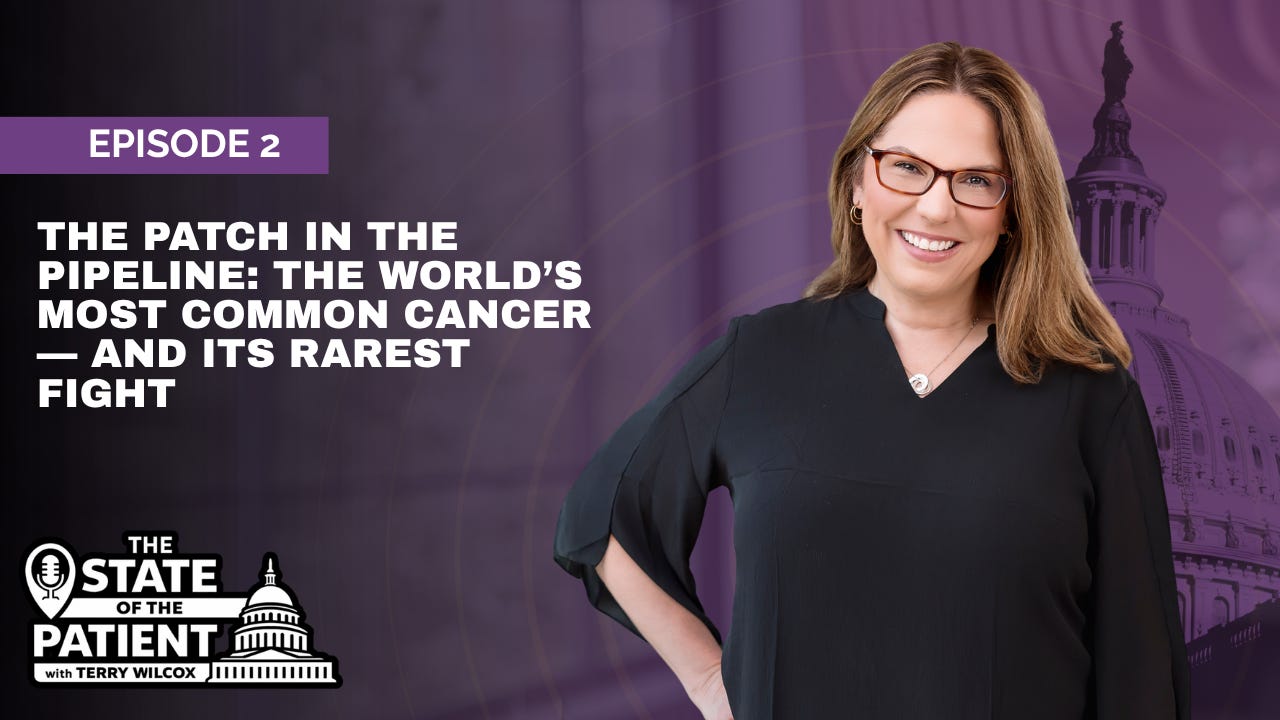
When I called my mother to record her interview for this episode, the first thing she did was turn her music down. Then she told me about the red dot.
She’d been to the dermatologist three months earlier. Clean checkup. My mother has gone every six months for twenty years — she’s a retired dentist, she does not miss appointments. And three months after that clean checkup, she noticed a little pinpoint spot on the right side of her nose. A pin dot. A little red place that looked like nothing. She watched it for three or four weeks. It didn’t go away. So she made the appointment herself.
The cream her dermatologist prescribed did nothing. The biopsy told them what it was: basal cell carcinoma. She had Mohs surgery, and that was that.
Her dermatologist didn’t miss anything. There was nothing to see three months earlier. That’s how this cancer works — it wasn’t there, and then it was, and the person best positioned to notice was the woman looking at her own face every morning. My mother says it plainly: pay attention to your own body. It’s the most practical sentence in the entire episode, and she’s been proven right twice now.
Skin cancer is not a stranger in my family. My mother’s had two. My step-dad has had several. If you grew up in Texas in the era before anyone said the word sunscreen, this is what the math looks like forty years later. Five million new cases of basal cell carcinoma in this country every year. It is the most common cancer in the world. Most of us know someone who’s had one, which is exactly why we’ve all learned to shrug at it. It’s just basal cell. It’s just skin cancer.
Making this episode taught me to stop saying “just.”
When my mother had her first Mohs surgery in 2014, it was scheduled within a week. Today, that same surgery is often booked ten to fourteen weeks out. There are only about five thousand surgeons trained to do it, they can perform roughly a million procedures a year, and there are five million new cases annually. The cancer didn’t get faster. The line got longer. If you’re waiting in it right now, “just skin cancer” doesn’t describe your spring.
Mark Smith, one of the patients in this episode, spent forty years working outdoors in Tennessee telecom. His first basal cell showed up as a spot on his cheek that bled when he shaved — no nick, no reason. Mohs handled it, but it took more tissue than he expected. So when his second one appeared on the tip of his nose, he did the arithmetic every patient in his position does: if they take that much off my nose, what will I look like? He researched his options himself and chose superficial radiation instead. Twenty treatments, twenty seconds each, three days a week. No scar. He’s glad he did it. But notice what the system asked of him — twenty appointments to protect his own face. Nobody in that story got anything easy.
And then there’s Julie.
Julie Breneiser has had about a thousand basal cell carcinomas. That’s not a typo. She has Gorlin syndrome, a rare genetic condition, and both of her adult children inherited it — her daughter was diagnosed at seven, her son at eight. Julie is a trained physician assistant, and she’ll tell you her training didn’t protect her from any of it. There’s a ritual in cancer treatment where you ring a bell when you finish. Julie’s community doesn’t get a bell. A doctor once told her directly: you will never be cancer free.
A few years ago, her community came close to something better. A topical treatment in clinical trials. Patients on it watched their basal cells go away — skin that had produced cancer their whole lives, clearing. Then the trial missed the FDA’s standard endpoint, which generally requires the drug to work at least fifty percent of the time, and it was over. Patients went from clear faces back to surgery every three to six months.
Julie made an argument on the podcast that I want more people in Washington to hear, because it’s not an emotional argument. It’s arithmetic. In a rare disease this relentless, a thirty percent reduction is enormous. She’s had a thousand cancers. A treatment that “failed” at thirty percent would have spared her three hundred surgeries. The trial called that a failure. She calls it three hundred surgeries.
So what did she do? In October of last year, she went on LinkedIn and sent a letter to the CEO of Medicus Pharma, Raza Bokhari, M.D., whose company is developing a dissolvable patch — SkinJect — for basal cell carcinoma. Four hundred microscopic needles, applied in three short office visits while you wait for your surgery date. In Phase 2 trials, three out of four treated lesions cleared on visual exam. I’ll say clearly what I said in the episode: the patch is investigational. It is not FDA-approved. Under the microscope, its complete-response rate is forty percent against an approval bar of more than fifty, and the next study will decide whether it closes that gap. Nobody can walk into a dermatologist’s office and ask for it today.
Dr. Bokhari answered Julie’s letter. They met. And there is now an orphan drug designation in motion for Gorlin syndrome — a community the original trials didn’t even include because they did not even know about them. If the science holds, a treatment could reach her community on a faster road than anyone expected. It happened because a patient wrote to a company, not the other way around.
I’ve spent years watching how this system treats patients. The honest summary is that it responds to the people who show up — the woman who books her own appointment about a red dot, the man who researches his own alternatives, the mother who writes the letter. That shouldn’t be the price of admission. But until it isn’t, I’m going to keep putting the people who paid it on the show.
Two practical things before you go. Look at your own skin this week — really look. If something new doesn’t go away in a few weeks, make the appointment. And wear sunscreen. My mother, who plays golf three days a week in Texas heat, does not step outside without it. She’s earned the right to lecture all of us.
Listen to the episode here: [EPISODE LINK]
If Gorlin syndrome touches your family, the Gorlin Syndrome Alliance. Tell them Julie sent you.