


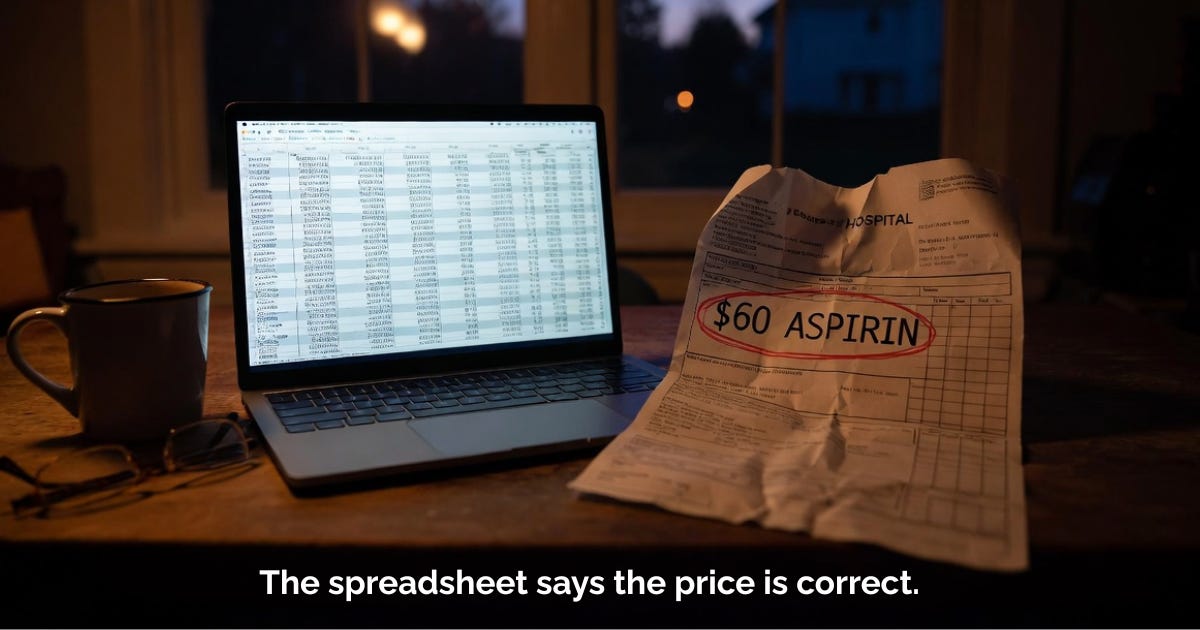
I’ll admit it right up front: when Peter Girnus’s viral piece “The Price Is Correct” started making the rounds, it got me. Not for a second but for longer than I’d like to admit.
It read like someone inside the system had finally decided to say the quiet part out loud. The piece walked readers through hospital chargemasters. Those are massive spreadsheets packed with sky-high list prices hospitals have been raising year over year for decades. It described them as deliberately inflated anchors, set high so insurers could negotiate what looked like generous “discounts” while hospitals still protected healthy margins.
A saline flush that costs pennies listed at $87. A cancer drug like Keytruda, acquired for around $11,000, bumped up to $40,000 or more in one facility. Same service, wildly different prices depending on who was paying or whether anyone was negotiating at all.
It was sharp, detailed, and disturbingly convincing.
And it wasn’t literally real.
Or maybe more accurately, it was not entirely fictional.
What made it land so hard is that it reflected a version of reality many of us already recognize from our own lives. I certainly did.
I grew up hearing about this exact dynamic at my own kitchen table. My dad was the CFO of a nonprofit hospital in Denver at a time when CFOs of hospitals could have an ashtray on their desk and a liquor cabinet in the office.
No, I’m not kidding. It was the 80’s.
He used to joke about the chargemaster all the time. He knew what a farce it was. He knew that no one actually paid those inflated list prices except the people who walked in off the street with no insurance and no one to negotiate for them. He also knew that most of those bills would never be paid in full. No one was really expected to pay $60 for an aspirin… except the person who had no negotiator at all.
Even back then, the “$60 aspirin” wasn’t really a joke it was a marker. I learned and understood what the chargemaster was: a necessary starting point in a complicated world of contracts and negotiations. And he also made it very clear to me — without a doubt — that those numbers had literally nothing to do with the care they were providing.
So when I read Girnus’s satire, it didn’t feel outrageous. It felt familiar.
Even if the piece exaggerated for effect, the core idea holds: the chargemaster is not a reflection of what care truly costs. It’s a negotiating tool. Hospitals set high “list” prices. Insurers negotiate them down. The whole system runs on leverage, not transparency.
But here’s the part that doesn’t get talked about enough: those prices don’t just sit on a spreadsheet. Someone eventually gets billed for them.
If you have good insurance, you have a powerful negotiator on your side. If you don’t — or if your plan decides a particular service “doesn’t count” — you’re suddenly exposed to a version of pricing that was never meant to be paid in full.
When my twins were born, the chargemaster bill for delivery and a seven-day NICU stay came to $250,000. Our insurance paid a fraction of that. We paid about $6,500 out of pocket. If we hadn’t had insurance? That $250,000 number wouldn’t have been theoretical. It would have been the number on the bill we were expected to pay.
As much as I spend time calling out insurers — and I do — this is the moment where the truth gets uncomfortable. When you walk into a hospital, you want someone negotiating on your behalf. You won’t hear me praise our current insurance conglomerates that often, but your need for them is real when you are exposed to the chargemaster rates all alone.
The people most exposed to chargemaster pricing are the ones with the least leverage: the uninsured, the under-insured, and the people whose care falls outside what a plan decides is “eligible.” They’re not just navigating the system. They’re absorbing its worst assumptions.
Transparency was supposed to fix some of this. In 2021, hospitals were required to publish their chargemaster rates, negotiated rates, and cash prices in machine-readable files. In theory, it was a big step forward. In practice, it’s mostly been a checkbox exercise, though more accountability measures have been passing at the state level recently thanks to PatientRightsAdvocate.org.
Hospitals post massive spreadsheets. Literally thousands of rows of technical codes with little context or translation. They’re technically compliant, but practically useless. And in many parts of the country, Certificate of Need laws (more to come on those) limit competition so severely that even if you could somehow decode the file, there often isn’t anyone else in town to negotiate with anyway.
Transparency without usability isn’t transparency. It’s just exposure without power.
A lot of important work has been done exposing these gaps, but for patients and families, we still have a long way to go. Disclosing the prices is one thing. Teaching people how to actually use them — how to read the file, compare options, and negotiate on their own behalf — will take time. It’s not that patients can’t understand it. They can. But for most of us, healthcare isn’t something we study until life forces the lesson.
Understanding usually arrives only after the bill does.
I’ve seen this play out in my own family in ways that still sting. After three surgeries for a cholesteatoma, my 12-year-old son needed a hearing aid. The doctor was clear: without it, school, conversations, even baseball would stay a struggle. We bought the device for $3,000.
Our insurance — after more than $25,000 a year in premiums — decided the entire expense didn’t count. Not toward the deductible. Not toward the out-of-pocket maximum. Not toward anything. In the eyes of the system, his ability to hear clearly simply didn’t exist.
We were fortunate. We had saved in our HSA and paid it without going into debt. But most families don’t have that cushion. And that’s where this system quietly does its damage — not always in one catastrophic bill, but in the steady accumulation of decisions: delay it, skip it, put it on a credit card, hope it doesn’t get worse.
This is why I keep coming back to one central idea in State of the Patient:
You are the CEO of your own healthcare — whether you like it or not.
Not because that’s how it should be. Because that’s how it is. No one is stepping in to simplify this for you — not the hospital, not the insurer, not your representatives, not your employer, and not your government.
Being the CEO doesn’t mean mastering billing codes. It means showing up differently: asking for the cash price before assuming insurance is your best option, requesting itemized bills and questioning what doesn’t make sense, understanding that “list price” is often just the opening move, and building whatever financial buffers you can — because the system quietly rewards preparation and punishes surprise.
It’s not fair. But ignoring it doesn’t make it go away.
That fake CEO confession went viral because it captured something people feel but don’t always know how to explain. The numbers looked absurd. But the structure behind them? That’s very real.
Our job now isn’t to argue about whether the satire was perfectly accurate. It’s to make sure more people understand what’s actually happening and how to navigate it.
Because once you see it, you can’t unsee it.
At Patients Rising, this is exactly what we’re trying to do: turn confusion into clarity, and frustration into action. Because the system may run on spreadsheets, but the heart of healthcare is local and real change starts around your kitchen table in the communities where you live.
Have you ever been hit with a bill that made no sense? Or had care denied because it didn’t “count”? Tell me in the comments or head on over to Patients Rising and share your story or join our community. I read every story and they matter more than any spreadsheet ever will.
If this resonated with you, subscribe to State of the Patient and share it with friends. We’re just getting started.
Well done! I've given your post a prominent link in an update to my article on patient advocacy:
https://drmick.substack.com/p/patient-advocacy